Water Bottle Business
Choosing 18.9L Water Bottles for a Bottled Water Business
Introduction
Selecting the right 18.9L / 5 gallon water bottle is one of the most important decisions a bottled water business will make. The bottle is the container that carries your product to the customer, and it is handled, filled, transported, delivered and reused many times over its service life. Bottle quality, durability, handling characteristics, filling-line compatibility, transport efficiency, customer use and consistent supply all affect how smoothly a bottled water operation runs. A bottle that cracks early, leaks, fails on a filling line or is inconsistent from batch to batch creates operational problems that cost time and money. This buyer’s guide is written for bottled water companies, water bottling businesses, water delivery businesses, water cooler businesses, distributors, new water businesses and established operations replacing or expanding their bottle supply — to help you make an informed decision about 18.9L water bottles that meets your long-term operating requirements.
Why 18.9L / 5 Gallon Water Bottles Are Popular
The 18.9L (5 gallon) format has become the standard large-format water bottle for bottled-water businesses and water-dispenser applications around the world. Its large capacity means a single bottle holds enough drinking water to supply an office, household or commercial premises for a meaningful period, which reduces the frequency of deliveries and refills. The format is compatible with the office water dispensers and residential water coolers that are designed around the 18.9L bottle’s dimensions and neck profile.
Because the bottles are reusable, a bottled water business can refill and sanitise each container many times, spreading the cost of the bottle across many delivery cycles. The size is manageable for manual handling — a full 18.9L bottle weighs close to 19 kg, which is about the upper limit one person can comfortably lift and invert onto a dispenser. These characteristics make 5 gallon water bottles suitable for a range of commercial applications, from office water dispensers and residential water coolers to hospitality, healthcare and institutional use.
1. Choose the Right Bottle Material
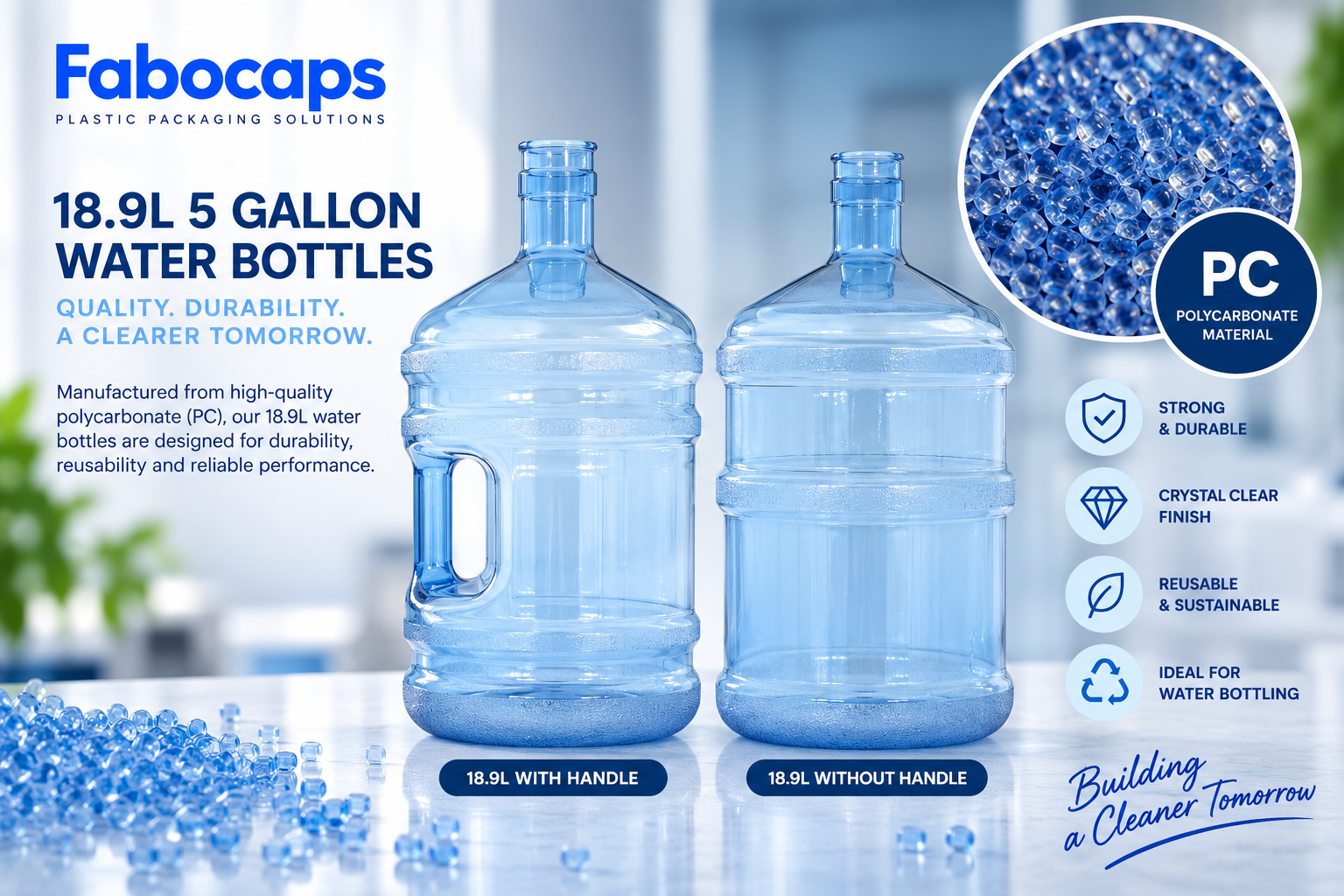
Material selection matters because the material sets the ceiling for the bottle’s clarity, strength, durability and suitability for reuse. Polycarbonate is the material most commonly used for clear, durable large-format water bottles, and its characteristics explain why. Polycarbonate is clear, which allows staff and customers to see the water level and confirm the bottle is clean. It is durable and impact-resistant, which means a bottle can survive the knocks, drops and temperature changes of a bottling and delivery operation without cracking. It is also lightweight relative to its strength, making it easier for staff to handle.
The material should be suitable for the intended application. For bottles used in a bottled water business — where the container comes into contact with drinking water and is reused many times — food-grade polycarbonate is specified to meet food-contact requirements. Buyers should confirm with their supplier that the material is food-grade and intended for reusable water applications.
Fabocaps manufactures food-grade 18.9L polycarbonate water bottles for bottled water businesses, bottling lines and dispenser networks across South Africa and Africa.
2. Consider Bottle Durability
Durability is a critical consideration for a bottled water business because an 18.9L bottle is handled many times during its service life. A single bottle may be filled, stored, transported, loaded onto a vehicle, unloaded, delivered to a customer, handled by customers, collected when empty, returned to the bottling facility, washed and refilled — and that cycle repeats many times before the bottle is retired.
A bottle that cracks, crazes or discolours early in its service life costs the business money in replacement costs and can interrupt operations. Good manufacturing quality and consistent bottle design are what stand behind durability — a well-made bottle with uniform wall formation, a clean neck finish and a stable base will survive the repeated handling, washing and transport of a bottling and delivery operation longer than a poorly made one. Buyers should ask the supplier about the recommended cleaning process and how the bottle is expected to perform over repeated refill cycles.
3. With Handle or Without Handle?
18.9L water bottles are available in two configurations: with a moulded handle and without a handle. The difference affects how bottles are lifted, carried, loaded, delivered, handled by customers, stored and used in day-to-day business operations.
A handled bottle gives the operator a fixed grip point, which makes a full bottle easier to lift, carry and invert onto a dispenser. For delivery staff who move dozens of bottles a day, a handle reduces strain and the risk of drops. A non-handled bottle has a smooth, continuous profile that some operations find easier to rack, stack and load by machine, and it may fit certain dispensing cradles more neatly.
The best configuration depends on the company’s specific workflow. A delivery route where drivers carry bottles into offices and homes will usually benefit from handles. An operation where bottles stay in racks and are loaded by equipment may not need them. Many bottled water businesses run both configurations for different routes or customers.
For a detailed comparison of the two configurations, read our article on the 5 Gallon Water Bottle With Handle vs Without Handle.
4. Check Bottle Neck and Closure Compatibility
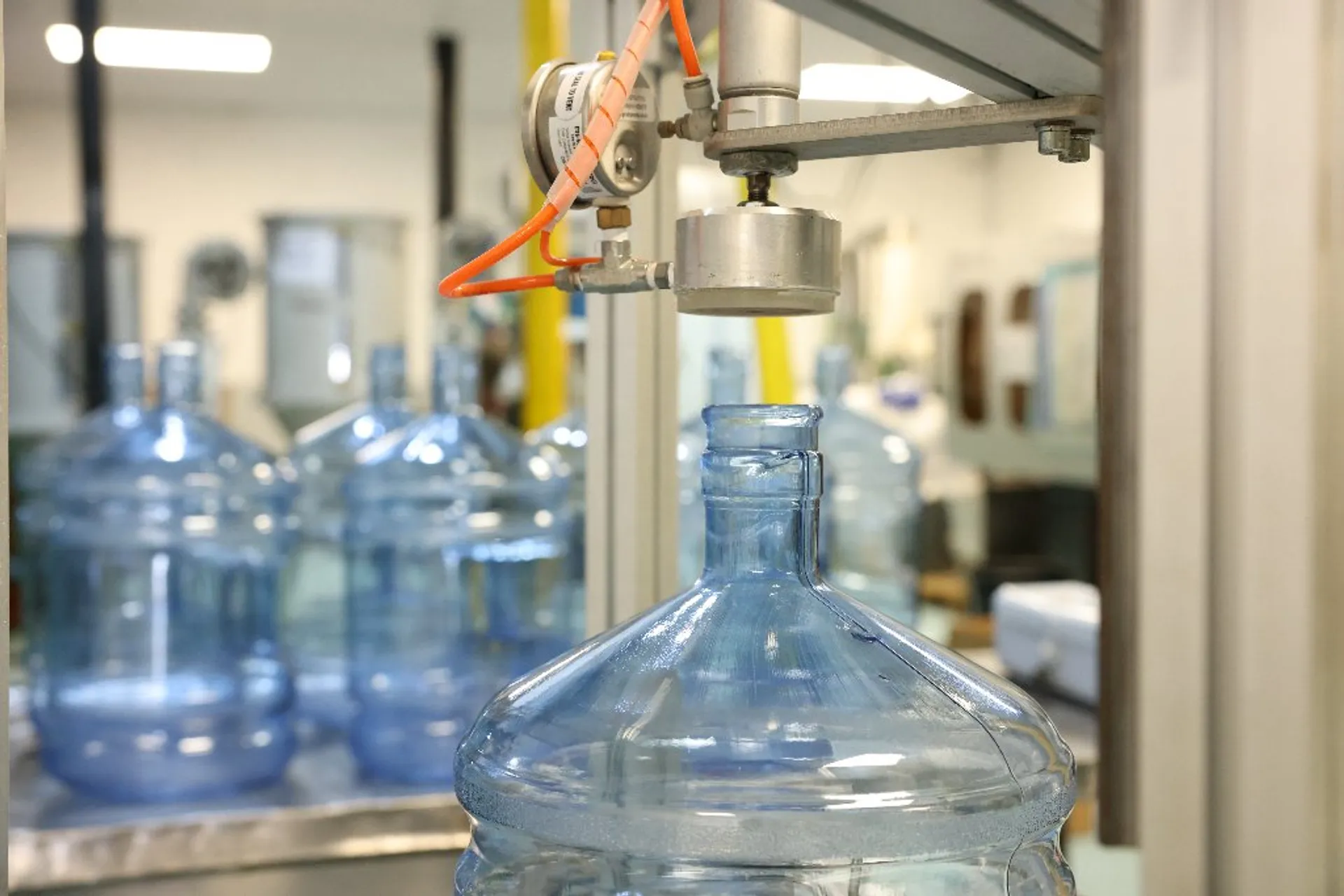
The bottle neck and closure system are important because they determine whether a bottle seals, fills and dispenses correctly. A 5 gallon water bottle must have a consistent, precisely moulded neck so that closures — whether non-spill caps, snap-on caps or screw caps — seat cleanly and seal properly. An inconsistent or poorly moulded neck leads to leaks, contamination risk and failed dispenser probes.
Non-spill closures are commonly used in bottled water businesses because they prevent water from spilling when the bottle is inverted onto a dispenser. For the closure to work, the bottle neck must be consistent bottle after bottle. Filling operations also depend on neck consistency — a bottling line runs smoothly only when every bottle accepts the cap the same way. Water dispenser use is the final test: if the neck and closure are compatible, the bottle seats cleanly on the dispenser probe and the customer gets a clean, leak-free experience.
Fabocaps supplies compatible non-spill closures and screw caps designed to work with its 18.9L polycarbonate water bottles.
5. Look for Consistent Manufacturing
Bottled water companies purchasing bottles in quantity need consistency, because variation causes operational problems. A buyer ordering hundreds or thousands of bottles needs every bottle to fill, seal, stack and dispense the same way. Consistent bottle shape, clarity, neck dimensions and overall appearance across the batch are all indicators of a controlled manufacturing process.
Manufacturing repeatability and product inspection are what stand behind that consistency. A manufacturer that controls the moulding process and inspects each bottle before dispatch — checking for clarity, surface appearance, shape, neck finish and visible defects — is more likely to deliver a consistent product than one that does not. Consistency helps businesses manage their filling and distribution processes: consistent bottles run smoothly on filling lines, fit dispensers correctly, seal properly with their closures, and stack and transport safely.
6. Quality Control and Food-Contact Considerations
Buyers should consider the quality controls and material suitability of their bottle supplier, because these factors determine whether the bottles they receive are consistent and appropriate for their application. Appropriate material, product inspection, manufacturing consistency and quality management together define how reliably a manufacturer can hold a standard. For a bottled water business, the material must be suitable for contact with drinking water, which is why food-grade polycarbonate is specified.
A supplier with a controlled quality process catches variation before bottles reach the customer. Learn more about Fabocaps quality standards and how each bottle is inspected before dispatch.
7. Consider the Total Operating Cost
The purchase price of a bottle is only one consideration. A bottled water business should look at the total operating cost over the life of the bottle, which includes product durability, handling, transport, bottle consistency, replacement requirements, supply reliability and operational efficiency.
A bottle that costs less upfront but cracks early or causes filling-line stoppages will cost more over its service life than a better-made bottle that lasts longer and runs smoothly. A consistent bottle reduces downtime on the filling line, fewer leaks mean fewer customer complaints, and a reliable supply means the business can plan production and delivery with confidence. Buyers should weigh these factors alongside the unit price rather than choosing on price alone.
8. Buying 18.9L Bottles in Quantity
Bottled water businesses typically purchase bottles in volume, and buying in quantity requires planning. Practical advice for purchasing 18.9L water bottles in bulk includes:
- Assess current bottle requirements based on fleet size, filling-line capacity and delivery frequency.
- Plan for future growth — a growing business needs a supplier that can scale with demand.
- Arrange repeat orders on a schedule that aligns with filling-line capacity and route demand.
- Plan storage — empty bottles take up space, and storage conditions should protect bottles from damage and contamination.
- Coordinate supply planning with delivery planning so that bottle arrivals do not disrupt operations.
- Maintain supplier communication — confirm quantities, configurations and schedules before placing an order.
Buyers should confirm minimum order quantities, prices, lead times and production capacity directly with the supplier, as these vary by manufacturer and are not standard across the industry.
9. Choosing an 18.9L Water Bottle Supplier
When evaluating a water bottle supplier for a bottled water business, consider the following checklist:
- Suitable material — food-grade polycarbonate appropriate for reusable water applications.
- Product quality — consistent, clear, durable bottles that perform reliably.
- Manufacturing capability — a supplier that controls the whole production process.
- Consistent production — the same bottle, batch after batch, across repeat orders.
- Quality management — inspection and quality control at every stage.
- Product options — bottles with and without handles, compatible closures.
- Closure compatibility — closures designed to work with the bottle neck.
- Supply reliability — stock availability and the ability to meet repeat-order demand.
- Communication — direct, responsive contact for quotations and product questions.
- Ability to support repeat orders — a supplier that can grow with your business.
10. Why Choose Fabocaps?
Fabocaps manufactures 18.9L / 5 gallon food-grade polycarbonate water bottles and related plastic products for bottled water businesses, bottling lines and dispenser networks across South Africa and Africa. Bottle options are available with and without handles to suit different operations. Explore our 18.9L polycarbonate water bottles, review our Fabocaps quality standards, learn more about Fabocaps, or Request a Quote for current pricing and lead times.
Frequently Asked Questions
What size is an 18.9L water bottle?
An 18.9L water bottle holds approximately 18.9 litres, which is equivalent to 5 US gallons. The two terms are used interchangeably in the bottled water industry to describe the same large-format, reusable dispenser bottle.
Why are 18.9L bottles used by bottled water businesses?
18.9L bottles are used because they hold enough water to supply an office or household for a meaningful period, they are compatible with standard water dispensers, and they are reusable — which makes them cost-effective for bottling and delivery operations that refill and redistribute bottles many times.
What material is commonly used for 18.9L water bottles?
Polycarbonate is the material most commonly used for reusable 18.9L water bottles because of its clarity, strength and impact resistance, which suit repeated filling, washing and refilling. Food-grade polycarbonate is specified for bottles in contact with drinking water.
Should I choose an 18.9L bottle with a handle or without a handle?
It depends on your workflow. If delivery staff carry bottles by hand to the point of use, a handle is usually preferred. If bottles stay in racks and are loaded by machine, a non-handled bottle may be more practical. Many businesses run both configurations for different routes or customers.
Why is bottle-neck consistency important?
Bottle-neck consistency is important because the neck determines cap fit, sealing performance and dispenser compatibility. A consistent neck ensures that closures seal correctly bottle after bottle, filling lines run smoothly, and bottles seat cleanly on water dispensers.
What should I look for when buying 18.9L bottles in bulk?
Look for suitable material, product quality, manufacturing consistency, neck and closure compatibility, quality control, supply reliability and the ability to support repeat orders. Confirm minimum order quantities, prices, lead times and production capacity directly with the supplier.
Does Fabocaps manufacture 18.9L polycarbonate water bottles?
Yes. Fabocaps manufactures 18.9L / 5 gallon food-grade polycarbonate water bottles and offers options with and without handles for bottled water businesses across South Africa and Africa.
Conclusion
Choosing the right 18.9L water bottle for a bottled water business comes down to bottle material, durability, handle configuration, neck and closure compatibility, manufacturing consistency, quality control, supply reliability and supplier capability. Each factor affects how the bottle performs in service — from the filling line to the customer’s dispenser — and together they determine the total cost and reliability of the operation. Looking for 18.9L 5 Gallon Water Bottles for your bottled water business? Request a Quote and our team will help you specify the right configuration for your operation.
Looking for 18.9L 5 Gallon Water Bottles?
Fabocaps manufactures and supplies 18.9L polycarbonate water bottles for customers in South Africa and across Africa.