Materials & Quality
How to Clean and Maintain an 18.9L Polycarbonate Water Bottle
Introduction
Proper cleaning and maintenance are essential for reusable 18.9L / 5 gallon polycarbonate water bottles. Because these bottles are refilled, transported, handled and reused many times over their service life, keeping them clean and in good condition protects both the product and the customer experience. This guide explains how businesses and users can properly clean, inspect and maintain an 18.9L polycarbonate water bottle. It is written for bottled water businesses, water delivery businesses, water cooler businesses, offices, commercial users, residential users and anyone responsible for maintaining reusable 18.9L water bottles. Cleaning practices should always be appropriate for the bottle material and the intended application — what follows is general guidance to help you establish a sound maintenance routine.
Why Proper Cleaning and Maintenance Matter
Regular cleaning is an important part of maintaining a reusable 18.9L water bottle. Over time, bottles that are refilled repeatedly can develop residue, water marks or mineral deposits inside the bottle, particularly in areas where water sits between refills. Regular cleaning helps maintain a clean appearance, which matters to both the business and the customer — a bottle that looks clean reinforces confidence in the water inside it.
Regular cleaning also provides an opportunity for regular inspection. Each time a bottle is cleaned, the person handling it can check for visible cracks, damage or changes in appearance. Identifying damage early means a bottle can be removed from circulation before it fails, which is better for operations and better for the customer. Cleaning and maintaining the bottle properly, as part of a consistent routine, helps the business get the full service life out of each container.
Cleaning an 18.9L Polycarbonate Water Bottle
A general cleaning process for an 18.9L polycarbonate water bottle involves the following steps:
- Empty the bottle completely.
- Rinse the bottle appropriately to remove loose residue.
- Clean the interior and exterior using an appropriate bottle-cleaning method suitable for polycarbonate.
- Pay attention to the bottle neck and areas where residue may collect.
- Rinse thoroughly after cleaning to remove any cleaning agent residue.
- Allow the bottle to dry appropriately before reuse.
If specific cleaning or sanitising instructions are provided by the bottle manufacturer, follow those instructions. If no manufacturer instructions are available, follow the cleaning and sanitation procedures applicable to your operation and the relevant regulatory requirements for bottled water or water delivery businesses in your region.
Cleaning vs Sanitising
It is important to understand the difference between cleaning and sanitising. These are two distinct steps, not the same process.
What is cleaning?
Cleaning is the physical process of removing dirt, soil, residue and visible contaminants from a surface. For a water bottle, this means washing away mineral deposits, organic matter and any visible soil from the interior and exterior of the bottle. Cleaning is the first step — it prepares the surface for effective sanitising.
What is sanitising / disinfection?
Sanitising (also referred to as disinfection) is a separate microbial-control step intended to reduce microorganisms on a clean surface to a level that is considered safe for the intended application. Sanitising should be carried out after appropriate cleaning and rinsing, because it is most effective on a surface that is already free of visible soil.
Why they are not the same
Cleaning does not automatically equal sanitisation. A cleaning product removes soil but may not kill or reduce microorganisms to the required level. A sanitising product is designed for microbial control but is most effective on a surface that has already been cleaned. A bottle should be cleaned first, rinsed, then sanitised using an appropriate approved process — not the other way around.
The specific products, concentrations and procedures used for sanitising should follow manufacturer guidance and the applicable food-safety or sanitation standards for your operation. Do not assume that a cleaning product also sanitises unless it is explicitly approved for that purpose.
Recommended Commercial Cleaning Solution: Polyclean BW
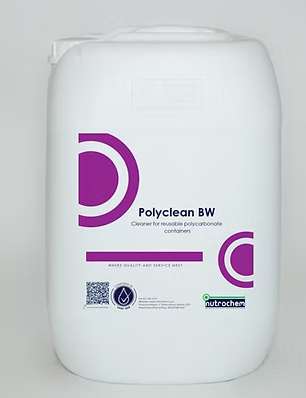
Commercial bottle-washing operations should use cleaning chemistry appropriate for reusable polycarbonate bottles and the specific washing equipment in use. An example of a commercial cleaning solution specifically formulated for reusable polycarbonate bottles is Polyclean BW by NutroChem.
NutroChem’s Polyclean BW is a cleaning solution designed for automatic washers used to clean reusable polycarbonate bottles and HOD (Home and Office Delivery) containers. NutroChem states that its formulation is designed to help protect polycarbonate bottles from stress cracking while assisting with the removal of dirt and stains and inhibiting mineral scale formation in washers.
View Polyclean BW by NutroChem
Polyclean BW is a NutroChem product. Fabocaps does not manufacture, own or distribute Polyclean BW, and there is no partnership between Fabocaps and NutroChem. The information above is presented as a product reference for commercial bottle-washing operators. Always follow the chemical manufacturer’s label, technical data sheet and your bottle-washing equipment procedures for dilution, dosing, temperature and contact time.
Recommended Sanitation Solution: Perasan A
After appropriate cleaning and rinsing, the next step in a commercial bottle-washing process is sanitisation or disinfection. Perasan A is a peracetic-acid-based antimicrobial sanitizer/disinfectant. The manufacturer of Perasan A describes it as ideal for food-contact surface sanitation and states that it can be used for bottle and filler sanitising in food and beverage processing applications.
It is important to be clear: Polyclean BW is relevant to the cleaning stage, while Perasan A is a sanitisation / disinfection product. These are separate steps and separate products — they should not be mixed together. Sanitation should be carried out after appropriate cleaning and rinsing, according to the applicable product instructions and the requirements of the bottle-washing system.
Perasan A is not a Fabocaps product. Fabocaps does not manufacture, own or distribute Perasan A, and there is no partnership between Fabocaps and the manufacturer unless such a partnership is already explicitly documented on the Fabocaps website. The information above is presented as a product reference. Commercial operators must follow the chemical manufacturer’s label, technical data sheet and their bottle-washing equipment procedures for concentration, dosage, contact time, temperature and rinse requirements.
General Cleaning and Sanitation Workflow
A practical commercial bottle-washing workflow follows a logical sequence. The principles below explain the order of operations — commercial operators should consult their chemical supplier, equipment manufacturer and applicable food-safety procedures for exact operating parameters.
STEP 1 — Inspect the bottle
Before any cleaning begins, inspect each bottle for visible cracks, deformation, damage or other issues. Remove damaged bottles from the process — there is no point cleaning a bottle that should be retired.
STEP 2 — Clean the bottle
Clean the bottle using an appropriate bottle-washing process and a cleaning solution suitable for reusable polycarbonate containers. The objective at this stage is to remove dirt, residue, mineral deposits and visible soil from the interior and exterior of the bottle.
STEP 3 — Rinse appropriately
Rinse the bottle according to the washing system’s design to remove cleaning agent residue before proceeding to sanitising.
STEP 4 — Sanitise / disinfect
Apply an appropriate approved sanitation or disinfection process using a product such as Perasan A, following the chemical manufacturer’s instructions for the specific bottle-washing system. This step reduces microorganisms on the clean, rinsed bottle surface.
STEP 5 — Final rinse or post-treatment
Perform a final rinse or post-treatment handling step according to the chemical manufacturer’s instructions and applicable requirements for food-contact surfaces.
STEP 6 — Inspect before reuse
After cleaning, rinsing and sanitising, inspect each bottle again before it is returned to service. Confirm the bottle is clean, undamaged and fit for reuse.
STEP 7 — Store and handle appropriately
Store cleaned bottles in a clean, dry, protected environment and handle them carefully to maintain their condition until they are refilled.
Do not mix cleaning chemicals. Do not mix Polyclean BW and Perasan A together. The correct process depends on the bottle-washing equipment, chemical product, bottle material, intended application and applicable food-safety requirements.
Inspecting the Bottle
Inspection should be part of routine bottle maintenance. After cleaning, when the bottle is empty and clean, take the opportunity to check the bottle thoroughly:
- Check for cracks — look for visible cracking in the bottle body, base or shoulder.
- Check for deformation — look for changes in shape, bulging or distortion.
- Check for significant scratches or surface damage that could affect the bottle’s appearance or performance.
- Check the neck — make sure the neck is intact and not damaged, as this affects closure fit.
- Check the base — make sure the base is stable and not cracked or worn.
- Check for changes in appearance — discolouration, cloudiness or crazing can indicate the bottle is nearing the end of its service life.
- Check for problems affecting closure fit — if the closure no longer seals properly, the neck may be damaged.
Visibly damaged bottles should be assessed according to the business’s quality-control procedures and manufacturer guidance. Bottles that are cracked, deformed or otherwise unsuitable for continued use should be removed from circulation.
Storage and Handling
How bottles are stored between uses affects their condition and service life. Good storage practices in general include:
- Avoid unnecessary impacts — bottles should be stored where they will not be knocked or bumped.
- Protect bottles from excessive heat — avoid storing bottles near heat sources.
- Avoid prolonged direct sunlight where appropriate — extended exposure to direct sunlight can affect the bottle material over time.
- Prevent crushing or deformation — bottles should be stored in a way that does not place pressure on them.
- Keep bottles protected when not in use — store empty bottles clean, dry and capped where appropriate.
For specific storage temperature limits, follow the bottle manufacturer’s guidance.
Proper handling can help reduce unnecessary physical damage to 18.9L water bottles. A full bottle weighs close to 19 kg, so the way it is lifted, carried, loaded, unloaded, transported and placed on a dispenser all affect the bottle’s condition over time. Lift with a secure grip, carry carefully, load and unload gently, secure during transport and place on dispensers carefully to avoid damaging the neck.
The handle configuration of the bottle affects how it is handled. For a detailed comparison of handled and non-handled bottles, read our article on the 5 Gallon Water Bottle With Handle vs Without Handle.
When a Bottle Should Be Removed From Service
There is no universal replacement date that applies to every 18.9L polycarbonate water bottle. How long a bottle lasts depends on how it is used, how it is cleaned, how it is handled and the conditions it is exposed to. Instead of relying on a fixed replacement schedule, replacement should be considered when there is:
- Cracking — visible cracks in the bottle body, base, shoulder or neck.
- Significant physical damage — chips, deep scratches or impact damage.
- Deformation — changes in shape, bulging or distortion.
- Damaged neck or closure area — a neck that no longer accepts closures properly.
- Other visible deterioration — discolouration, cloudiness or crazing that does not resolve with cleaning.
- Any condition that makes the bottle unsuitable for its intended use.
For more information on the service life of polycarbonate bottles, read our article How Long Do Polycarbonate Water Bottles Last?.
Maintenance Tips for Water Businesses
For bottled water businesses, water delivery companies and water cooler businesses, a structured approach to bottle maintenance helps maintain quality and reduce unnecessary costs. A practical checklist includes:
- Establish a consistent cleaning procedure — every bottle should be cleaned the same way, every time.
- Inspect bottles regularly — build inspection into the cleaning and refilling routine.
- Separate damaged bottles — remove cracked, deformed or otherwise unsuitable bottles from circulation immediately.
- Store bottles properly — protect empty bottles from impacts, excessive heat and prolonged sunlight.
- Handle bottles carefully — train staff on correct lifting, carrying and loading techniques.
- Follow appropriate manufacturer guidance — use cleaning products and methods approved for polycarbonate.
- Maintain consistent quality-control procedures — keep records of cleaning, inspection and bottle withdrawal.
Why Material-Specific Cleaning Matters
Cleaning chemistry that is suitable for one type of plastic may not be suitable for another. Polycarbonate has specific material properties — it is clear, rigid and impact-resistant — but it can be affected by certain chemicals or cleaning conditions. Using a cleaning solution specifically formulated for reusable polycarbonate bottles, such as Polyclean BW, helps ensure the cleaning process is appropriate for the material and does not contribute to stress cracking, crazing or discolouration over time.
Commercial operators should always confirm that the cleaning and sanitation products they use are compatible with polycarbonate and with their bottle-washing equipment. Consult the chemical manufacturer’s technical data sheet and the bottle manufacturer’s guidance before use.
What to Avoid When Cleaning Polycarbonate Bottles
When cleaning a polycarbonate water bottle, take the following precautions to avoid unnecessarily damaging the bottle:
- Avoid abrasive cleaning methods that could scratch or damage the bottle surface.
- Avoid aggressive chemicals unless confirmed suitable for polycarbonate by the chemical manufacturer.
- Avoid excessive heat unless specifically approved for the bottle by the bottle manufacturer.
- Avoid using sharp objects or tools inside the bottle that could scratch or crack the interior surface.
- Avoid rough handling during cleaning — bottles should be handled carefully even when empty.
Do not mix cleaning chemicals. Do not mix different cleaning or sanitation products together. Always follow the chemical manufacturer’s instructions for each product.
Why Choose Quality Polycarbonate Bottles
Maintenance is only one part of bottle performance. The quality of the bottle itself — material quality, manufacturing consistency, bottle design, neck consistency, surface quality and quality control — determines how well the bottle will perform in service and how long it will last. A well-made bottle is easier to clean, resists damage better and provides a longer service life than a poorly made one.
Learn more about Fabocaps quality standards and how each bottle is inspected before dispatch. For an overview of the manufacturing process, read about how 18.9L polycarbonate water bottles are manufactured.
Why Choose Fabocaps 18.9L Polycarbonate Water Bottles?
Fabocaps manufactures 18.9L / 5 gallon food-grade polycarbonate water bottles and offers options with and without handles, produced for bottled water businesses, bottling lines and dispenser networks across South Africa and Africa. Explore our 18.9L polycarbonate water bottles, review our Fabocaps quality standards, learn more about Fabocaps, or Request a Quote for current pricing and lead times.
Frequently Asked Questions
How often should an 18.9L water bottle be cleaned?
Cleaning frequency depends on the bottle’s use and the operating procedures of the water business or user. Bottled water businesses typically clean and sanitise bottles between each refill cycle. Follow applicable manufacturer and sanitation procedures for your operation.
What is the difference between cleaning and sanitising?
Cleaning removes dirt, soil and residue from a surface. Sanitising is a separate step that reduces microorganisms on a clean surface. A bottle should be cleaned first, rinsed, then sanitised — they are not the same step.
What cleaning solution should I use for polycarbonate bottles?
Use a cleaning solution specifically formulated for reusable polycarbonate bottles, such as Polyclean BW by NutroChem. Always confirm compatibility with your bottle-washing equipment and follow the chemical manufacturer’s instructions.
What is Polyclean BW?
Polyclean BW is a cleaning solution by NutroChem, designed for automatic washers used to clean reusable polycarbonate bottles and HOD containers. NutroChem states that its formulation is designed to help protect polycarbonate bottles from stress cracking while assisting with the removal of dirt and stains and inhibiting mineral scale formation in washers. Polyclean BW is a NutroChem product, not a Fabocaps product.
What is Perasan A?
Perasan A is a peracetic-acid-based antimicrobial sanitizer/disinfectant described by its manufacturer as ideal for food-contact surface sanitation, including bottle and filler sanitising in food and beverage processing. Perasan A is a sanitation product, not a cleaning product, and should be used after appropriate cleaning and rinsing. Perasan A is not a Fabocaps product.
Can I mix Polyclean BW and Perasan A together?
No. Do not mix cleaning chemicals. Polyclean BW is a cleaning product and Perasan A is a sanitation product — they are used in separate stages of the bottle-washing process. Follow each chemical manufacturer’s instructions for their respective product.
Can I use abrasive cleaners on a polycarbonate water bottle?
Abrasive cleaning methods should generally be avoided unless specifically approved by the bottle manufacturer. Abrasive cleaners and tools can scratch the polycarbonate surface, which may affect the bottle’s appearance and performance over time.
How do I know when an 18.9L bottle needs to be replaced?
Check for visible damage, cracking, deformation, damaged neck or closure area, discolouration or any other visible deterioration. A bottle that shows any of these signs should be assessed according to the business’s quality-control procedures and removed from circulation if unsuitable for continued use.
How should 18.9L bottles be stored?
Store bottles in a clean, dry location protected from unnecessary impacts, excessive heat and prolonged direct sunlight. Avoid crushing or deformation and keep bottles protected when not in use. Follow manufacturer guidance for any specific storage requirements.
Conclusion
Proper cleaning and maintenance of an 18.9L polycarbonate water bottle involves appropriate cleaning, proper rinsing, suitable sanitising procedures, careful handling, correct storage, regular inspection and replacing damaged bottles when necessary. A consistent maintenance routine protects the bottle, the product and the customer experience, and helps the business get the full service life out of each container. Looking for quality 18.9L 5 Gallon Water Bottles? Request a Quote and our team will help you specify the right configuration for your operation.
Looking for 18.9L 5 Gallon Water Bottles?
Fabocaps manufactures and supplies 18.9L polycarbonate water bottles for customers in South Africa and across Africa.