Materials & Quality
What Is Food-Grade Polycarbonate and Why Does It Matter?
Introduction
When a bottled-water business, water-delivery company, water distributor, commercial buyer or packaging buyer sources reusable 18.9L / 5 gallon water bottles, one of the first questions that should arise is whether the material used to manufacture the bottle is suitable for contact with drinking water. “Food-grade polycarbonate” is the term most commonly used to describe material intended and suitable for that purpose. This article explains what food-grade polycarbonate means, what it does not mean, why material quality matters for reusable water bottles, how food-contact suitability differs from simply being made from plastic, why manufacturing consistency matters, and what buyers of 18.9L / 5 gallon water bottles should look for when evaluating a supplier.
What Is Polycarbonate?
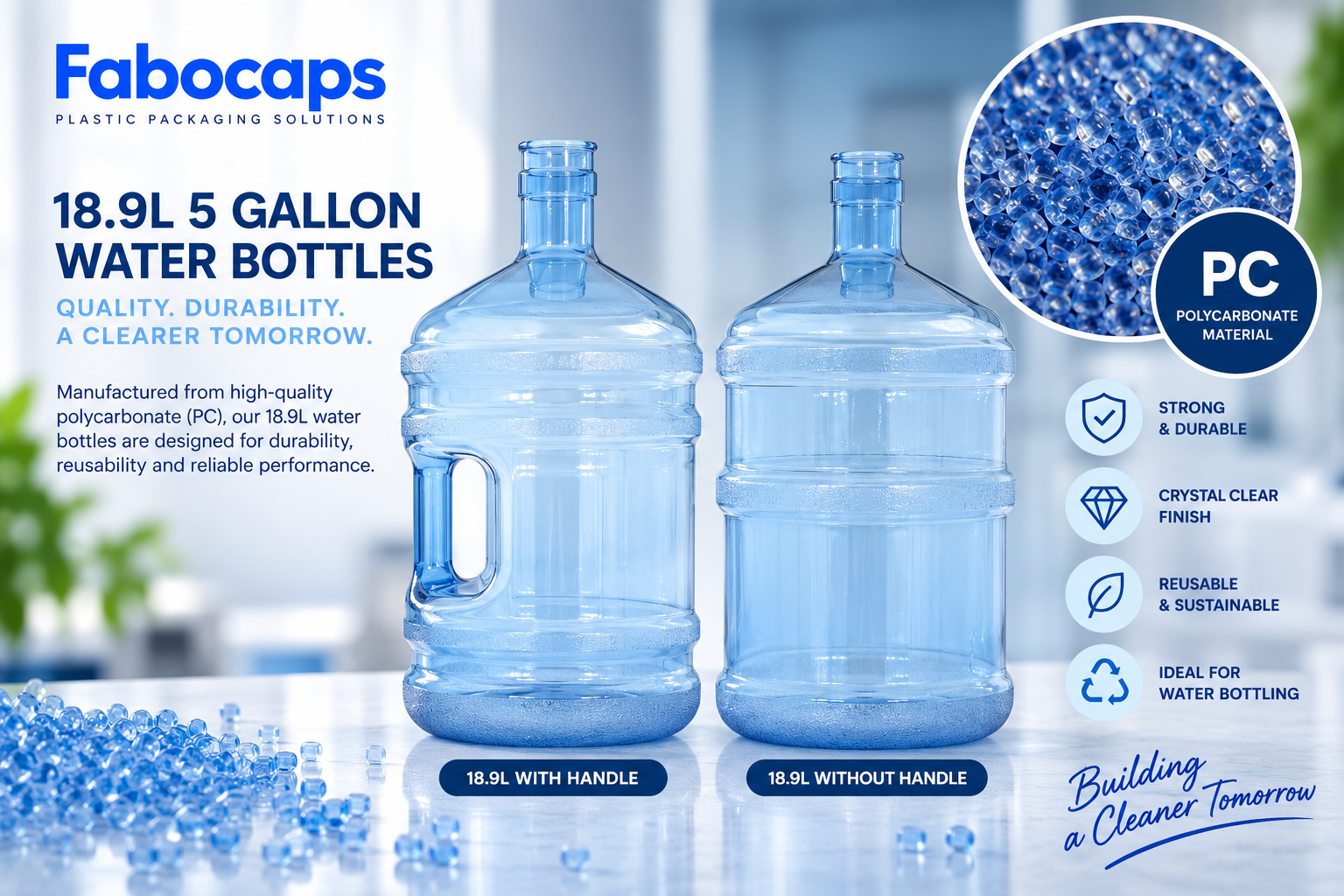
Polycarbonate (PC) is a strong, clear thermoplastic used in a wide variety of applications, including reusable beverage and water containers. It is known for its clarity, strength and impact resistance — properties that make it suitable for large-format, reusable bottle applications where the container has to survive repeated handling, washing, transport and refilling.
Polycarbonate is transparent, which allows operators and customers to see the water level and cleanliness inside a bottle. It is rigid and strong, which means a bottle can hold its shape under the weight of nearly 19 litres of water. It is impact-resistant, which means it can withstand the knocks and drops of a delivery operation better than many other plastics. And it can be formed into large-format containers, which is why it is widely used for 18.9L / 5 gallon water bottles.
These properties are genuine, but they should not be exaggerated. Polycarbonate is not universally superior to every other plastic, and it is not indestructible. Like any material, it has limits, and its performance depends on the quality of the material, the manufacturing process, the bottle design and the conditions of use. The fact that a bottle is made from polycarbonate does not, by itself, tell you everything you need to know about its suitability for a given application.
What Does “Food-Grade Polycarbonate” Mean?
The term “food-grade” generally refers to material intended and suitable for contact with food or beverages when used under the appropriate conditions. In the context of a water bottle, food-grade polycarbonate is polycarbonate material that is formulated and intended for food-contact or beverage-contact applications.
It is important to understand that food-contact safety is not determined simply by the plastic name. The fact that a material is polycarbonate does not automatically mean it is suitable for food contact. The finished product can involve the polymer or resin itself, additives, colourants, processing aids, the manufacturing conditions, the intended use and the conditions of use. Food-contact suitability depends on the specific material and intended conditions of use — not on the generic name of the plastic.
This is why “food-grade polycarbonate” is a more specific claim than simply “polycarbonate.” It refers to material that is intended and suitable for contact with food or beverages under applicable conditions and requirements. It does not mean that every product made from polycarbonate is automatically suitable for food contact, and it does not mean that the words “food-grade” alone prove compliance with every country’s regulations. Food-contact suitability depends on the specific material, formulation, manufacturing process, intended application and applicable requirements.
Why Food-Contact Suitability Matters
Food-contact suitability matters because a reusable 18.9L water bottle is in direct, repeated contact with drinking water. The bottle is not just a container — it is part of the food-contact chain. If the material is not suitable for that purpose, substances from the material could potentially migrate into the water, which is why food-contact materials are evaluated according to their intended use and conditions.
For a bottled-water business or water-delivery company, the food-contact suitability of the bottle material is not a minor detail. It is a fundamental requirement. The bottle carries drinking water to a customer, and the material must be appropriate for that application. Using material that is not intended or suitable for food contact is not an option for a bottle that carries drinking water, regardless of cost or convenience.
Why Polycarbonate Is Used for 18.9L Water Bottles
Polycarbonate is widely used for reusable 18.9L / 5 gallon water bottles because its combination of properties suits the demands of a large-format, reusable water container. The properties that make it well suited to this application include:
- Clarity — the transparent material allows operators and customers to see the water level and inspect the bottle’s cleanliness visually.
- Durability — a polycarbonate bottle can withstand the repeated handling, washing, transport and refilling of a delivery operation.
- Impact resistance — the material resists cracking and breaking from the knocks and drops that are inevitable in a delivery round.
- Reusable bottle applications — polycarbonate can withstand the hot washing and sanitising processes used between refill cycles.
- Handling — the material is lightweight relative to its strength, which makes a full 18.9L bottle easier for staff to lift and carry.
- Visibility of the water level — clarity means the water level is visible at all times, which matters for both operators and customers.
- Suitability for large-format bottle manufacturing — polycarbonate can be formed into the large-format bottle shapes required for 18.9L / 5 gallon containers.
These properties explain why polycarbonate is the material most commonly chosen for reusable large-format water bottles. However, the language should remain balanced. Polycarbonate is not claimed to last a specific number of reuse cycles, it does not have a specific universal lifespan, and it is not indestructible. Its performance in service depends on the quality of the material, the manufacturing process, the bottle design, the handling, the cleaning process and the conditions of use.
Important Properties of Polycarbonate
The properties that make polycarbonate suitable for reusable 18.9L water bottles are related to its nature as a strong, clear thermoplastic. The most relevant properties are:
- Transparency — polycarbonate is clear, which allows visual inspection of water level and bottle cleanliness.
- Strength — the material is rigid and strong enough to hold its shape under the weight of nearly 19 litres of water.
- Impact resistance — polycarbonate resists cracking and breaking from impacts better than many other plastics.
- Suitability for reusable container applications — the material can withstand the repeated washing and refilling of a reusable bottle operation.
- Ability to be formed into large-format water bottles — polycarbonate can be moulded into the 18.9L / 5 gallon bottle format used on water dispensers.
These properties are inherent to the material, but they are realised in the finished product only when the material quality, formulation, manufacturing process and bottle design are appropriate. A poorly made bottle from good material will not perform the way a well-made bottle from the same material will.
Food Contact, Migration and Intended Use
An important concept in food-contact materials is migration. Migration refers to the potential transfer of substances from a food-contact material into the food or beverage it contains. Substances from food-contact materials can potentially migrate into food or beverages, which is why food-contact regulations evaluate materials according to their intended use and conditions.
This is why food-contact suitability is tied to the intended use and conditions of use of the finished article. A material that is suitable for one application may not be suitable for another, and a material that is suitable under one set of conditions may not be suitable under different conditions. The intended use, the type of food or beverage, the temperature, the contact time and the condition of the material all matter.
The United States Food and Drug Administration (FDA) explains that food-contact substances are assessed for their intended use, including migration and toxicological information. This means that food-contact suitability is evaluated based on how the material performs under the specific conditions of its intended application, not just on the generic identity of the plastic.
This article presents this information as general educational background. It is not a legal or regulatory guarantee for any specific product, including Fabocaps products. Buyers should request appropriate material and food-contact documentation from their supplier when this information is important to their application.
Food-Contact Regulations and Standards
Food-contact requirements vary between markets. Different countries and regions have their own food-contact regulations, standards and approval frameworks, and a material that meets the requirements of one market may not automatically meet the requirements of another.
For example, the FDA regulates food-contact substances according to their authorised uses and conditions of use. The European Commission explains that food-contact materials must comply with applicable food-contact legislation and that plastic food-contact materials are subject to specific requirements. These are two of the most widely referenced food-contact frameworks, but they are not the only ones, and requirements in other markets may differ.
This section is educational background only. It is not a statement that the FDA certifies Fabocaps, nor a claim of EU certification, nor a claim of any specific Fabocaps regulatory approval unless such approval is already documented in verified Fabocaps product documentation. Buyers should request applicable documentation from their supplier and confirm the requirements that apply to their specific market and application.
Food-Grade Polycarbonate and BPA
Bisphenol A (BPA) is a substance associated with the manufacture of certain polycarbonate plastics. The FDA states that BPA is a component used in polycarbonate plastic and that its current assessment considers approved uses of BPA in food containers and packaging safe. This is provided as background information from a reputable regulatory source.
However, it is important to be clear about what this does and does not mean. Not all polycarbonate products have the same BPA status. The term “food-grade” and the term “BPA-free” are different claims and should not automatically be treated as interchangeable. A food-grade material is not automatically BPA-free, and a BPA-free claim is a separate claim that should be supported by its own documentation.
This article does not claim that Fabocaps bottles are BPA-free unless that is explicitly supported by current Fabocaps documentation, and it does not make any health claims. Buyers should request appropriate material and food-contact documentation from their supplier when BPA information is important to their application, and should not assume that the general term “food-grade” is equivalent to a BPA-free claim.
Food-Grade Does Not Mean “Every Polycarbonate Product Is the Same”
A common misunderstanding is the assumption that all polycarbonate products are the same. They are not. Even within the category of food-grade polycarbonate, the finished product can vary in material quality, formulation, manufacturing process, bottle design, dimensions, surface quality and overall performance.
The finished article matters because the material is only one input. A bottle made from food-grade polycarbonate resin can still vary in clarity, wall consistency, neck precision, surface quality and dimensional accuracy depending on how it is manufactured. Two bottles made from the same grade of material by different manufacturers can perform differently in service.
This is why buyers should not treat “food-grade polycarbonate” as a complete specification. It is a starting point. The material must be food-grade, but the finished product must also be well-made, consistent and appropriate for the intended application.
Manufacturing Quality Matters
The quality of the finished bottle depends on more than simply selecting polycarbonate resin. Material selection is the first step, but the quality of the bottle that reaches the customer is determined by the whole manufacturing process. The factors that matter include:
- Consistent raw materials — using the correct grade of material, consistently and free from contamination.
- Controlled manufacturing — a controlled moulding process that produces consistent results bottle after bottle.
- Consistent bottle dimensions — every bottle should have the same shape, weight and geometry.
- Neck and closure consistency — the neck must be precisely moulded so that closures seat and seal correctly.
- Wall and body consistency — uniform wall formation avoids thin spots that can crack under stress.
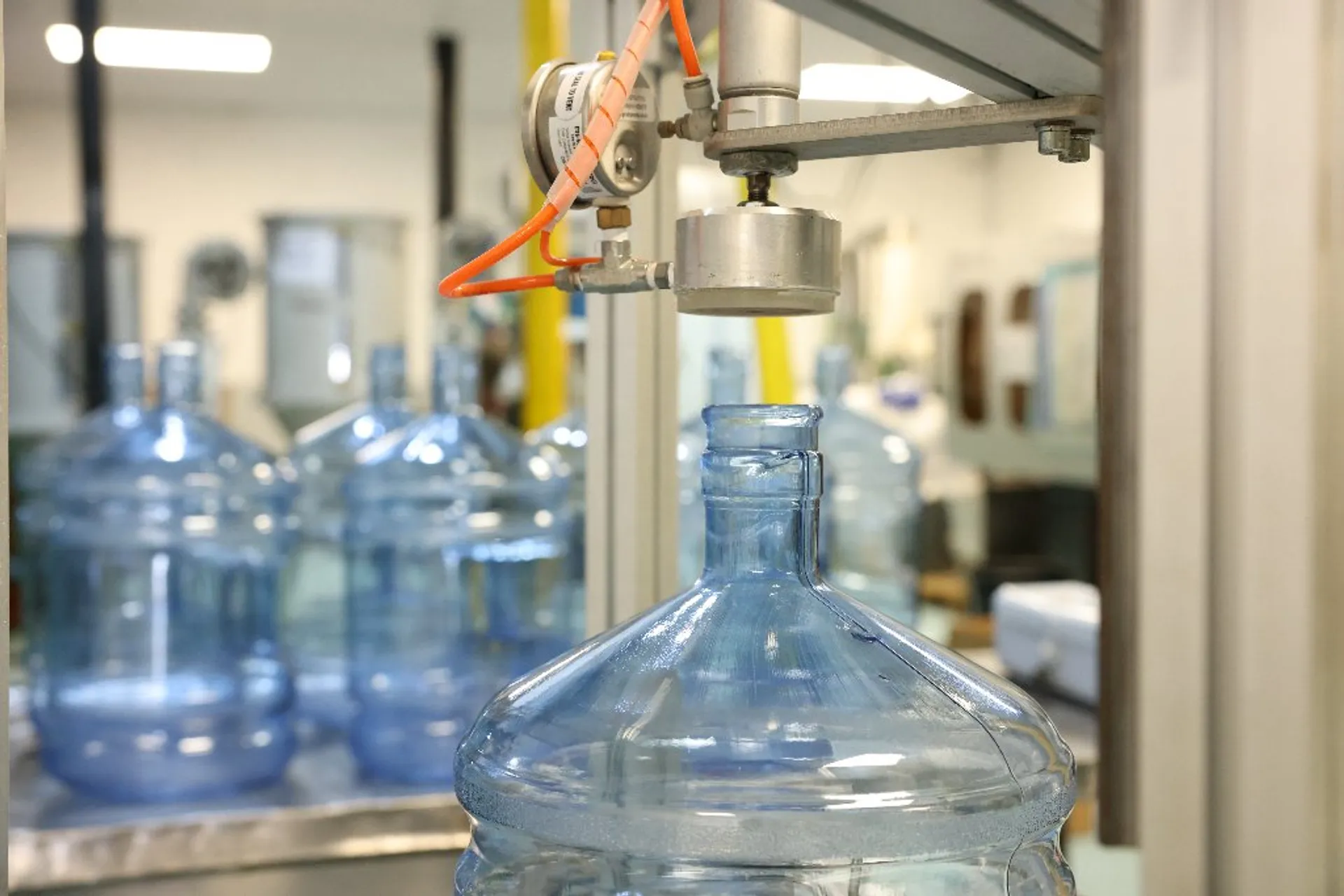
- Visual inspection — each bottle should be inspected for clarity, surface appearance, shape and visible defects before dispatch.
- Quality control — a quality management process that catches variation before it reaches the customer.
- Appropriate handling and packaging — bottles should be handled and packaged so they arrive in good condition.
This article does not invent manufacturing tolerances or test results, and it does not invent certifications. It explains the factors that buyers should understand when evaluating the manufacturing quality of a bottle supplier. A manufacturer that controls material selection, moulding, inspection and quality management is more likely to deliver a consistent, suitable product than one that does not.
Learn more about Fabocaps quality standards and how each bottle is inspected before dispatch.
Cleaning and Maintenance Matter
Food-contact suitability does not remove the need for proper bottle hygiene. A reusable 18.9L water bottle must be appropriately cleaned, sanitised, inspected, handled and stored between refill cycles. The material being food-grade means the bottle is suitable for contact with drinking water under appropriate conditions — it does not mean the bottle can be used without proper cleaning and maintenance.
Reusable bottles should be appropriately cleaned and sanitised between refills, inspected regularly for visible damage, handled carefully to avoid unnecessary impacts, and stored in conditions that protect them from contamination and damage. These practices are part of maintaining the food-contact suitability of the bottle over its service life.
For detailed guidance, read our article on How to Clean and Maintain an 18.9L Polycarbonate Water Bottle.
Commercial bottle-washing operations should use cleaning and sanitation processes appropriate for polycarbonate and the specific washing equipment. The cleaning chemistry, sanitation process, temperatures and rinse procedures should all be appropriate for the material, the bottle design and the applicable food-safety requirements for the operation.
What Should You Ask Your 18.9L Bottle Supplier?
A practical buyer checklist helps commercial buyers, packaging buyers and water businesses evaluate a supplier of 18.9L / 5 gallon water bottles. The following questions cover the key areas that determine whether a bottle is suitable for a reusable water application:
- 1. What material is used? — Confirm the bottle is manufactured from polycarbonate and that the material is food-grade.
- 2. Is the bottle intended for food/water contact? — Confirm the material is intended and suitable for contact with drinking water.
- 3. What material and product documentation is available? — Ask for material specifications and applicable food-contact documentation.
- 4. How is manufacturing quality controlled? — Ask about the quality control and inspection processes used.
- 5. Are bottle dimensions and neck finishes consistent? — Consistency matters for filling, sealing and dispensing.
- 6. What closure/cap system is compatible? — Confirm the bottle neck is designed to work with the intended closures.
- 7. What cleaning and maintenance process is recommended? — Ask for guidance appropriate to polycarbonate and the intended application.
- 8. What quality standards or certifications apply to the product? — Ask for applicable documentation rather than assuming.
- 9. Where is the bottle manufactured? — Know the origin of the product and the manufacturing location.
- 10. Can the supplier support ongoing commercial volumes? — Confirm the supplier can meet repeat-order demand over time.
These questions help a buyer move beyond a price comparison and evaluate a supplier on the factors that determine whether the bottle is suitable, consistent and reliable for a reusable water application.
How Fabocaps Uses Polycarbonate for 18.9L Water Bottles
Fabocaps manufactures 18.9L / 5 gallon food-grade polycarbonate water bottles for reusable water applications, producing bottles for bottling lines, delivery fleets and dispenser networks across South Africa and Africa. Bottle options are available with and without handles to suit different operations.
Material quality, manufacturing consistency and quality control are central to how Fabocaps produces reusable water bottles. Each bottle is inspected before dispatch, and the manufacturing process is controlled to produce consistent bottle dimensions, neck finishes and surface quality batch after batch.
Explore our 18.9L polycarbonate water bottles, review our Fabocaps quality standards, learn more about Fabocaps, or Request a Quote for current pricing and lead times.
This article does not invent certifications, test results, migration results, laboratory results, BPA-free claims or regulatory approvals. If a claim cannot be verified from existing Fabocaps website or product documentation, it is not made here. Buyers should request applicable material and food-contact documentation directly from Fabocaps when this information is important to their application.
Frequently Asked Questions
What is food-grade polycarbonate?
Food-grade polycarbonate refers to polycarbonate material or formulation that is intended and suitable for contact with food or beverages under applicable requirements and conditions of use. It is a more specific claim than simply “polycarbonate” and depends on the specific material, formulation, manufacturing process and intended application.
Is all polycarbonate food-grade?
No. Food-contact suitability depends on the specific material, formulation, intended use and applicable requirements. Not all polycarbonate products are intended or suitable for food contact, and the words “food-grade” alone do not prove compliance with every country’s regulations.
Why is polycarbonate used for 18.9L water bottles?
Polycarbonate is used for 18.9L water bottles because of its combination of clarity, strength, impact resistance and suitability for reusable large-format containers. These properties suit the repeated filling, washing, transport and handling of a delivery operation.
Does food-grade mean BPA-free?
No. “Food-grade” and “BPA-free” are different claims and should not automatically be treated as interchangeable. A food-grade material is not automatically BPA-free, and a BPA-free claim should be supported by its own documentation. Buyers should request appropriate documentation from their supplier when BPA information is important to their application.
How should an 18.9L polycarbonate bottle be maintained?
A reusable 18.9L polycarbonate bottle should be appropriately cleaned, sanitised, inspected, handled and stored between refill cycles. Commercial bottle-washing operations should use cleaning and sanitation processes appropriate for polycarbonate and the specific washing equipment.
How do I choose a quality 5 gallon water bottle?
Look for material quality, food-contact suitability, manufacturing consistency, closure compatibility, quality control and supplier documentation. Ask the supplier what material is used, whether the bottle is intended for food/water contact, what documentation is available, how quality is controlled, and whether the supplier can support ongoing commercial volumes.
Conclusion
Food-grade polycarbonate is material intended and suitable for contact with food or beverages under applicable conditions and requirements. It is not a universal label that applies to every polycarbonate product, and food-contact suitability depends on the specific material, formulation, manufacturing process, intended application and applicable requirements. For buyers of 18.9L / 5 gallon water bottles, material quality, food-contact suitability, manufacturing consistency, cleaning and maintenance, and supplier documentation together determine whether a bottle is suitable for a reusable water application. Looking for 18.9L 5 Gallon Water Bottles? Request a Quote and our team will help you specify the right configuration for your operation.
Looking for 18.9L 5 Gallon Water Bottles?
Fabocaps manufactures and supplies 18.9L polycarbonate water bottles for customers in South Africa and across Africa.