Materials & Quality
Reusable 18.9L Water Bottles: What Businesses Need to Know
Introduction
Reusable 18.9L / 5 gallon water bottles are a core operational asset for bottled-water businesses, water delivery companies, water distributors, water shops, office water suppliers, commercial water bottlers, packaging buyers and any business purchasing bottles in bulk. Unlike single-use containers, a reusable bottle is filled, transported, delivered, collected, washed and refilled many times over its service life, which means the choice of bottle affects operations, costs and customer experience in ways that a one-off purchase does not. This article explains the business considerations of reusable 18.9L water bottles — durability, handling, cleaning, sanitation, operational efficiency, bottle quality, consistency, supplier selection, total cost of ownership, logistics and replacement planning — so that commercial buyers can make informed decisions. It does not make unsupported claims about exact cost savings, return on investment, or a specific number of years or refill cycles a bottle will last.
Why 18.9L / 5 Gallon Bottles Are Common in Water Businesses
The 18.9L (5 gallon) bottle is a widely used large-format water-container size for home and office delivery, water dispensers, bottled-water businesses, commercial water supply and refill and delivery operations. A single 18.9L bottle holds enough drinking water to supply an office, household or commercial premises for a meaningful period, which reduces the frequency of deliveries and refills. The format is compatible with standard water dispensers and coolers, which are designed around the bottle’s dimensions and neck profile.
The description “5 gallon” is commonly used alongside the metric 18.9L designation because five US gallons equals approximately 18.9 litres. The two terms are used interchangeably across the bottled-water industry. Because the bottles are reusable, a business can refill and sanitise each container many times, which makes the 18.9L format a practical container for water delivery and distribution operations.
What Makes a Bottle “Reusable”?
A bottle is not “reusable” simply because someone refills it. Reusable bottle suitability depends on the bottle’s material, design, manufacturing quality, intended application, handling, cleaning, sanitation, inspection and storage. A bottle intended for reuse is designed and manufactured to withstand repeated filling, washing, transport and handling, which places demands on the material and the bottle design that a single-use container is not built to meet.
It is important not to equate “reusable” with an unlimited service life. There is no fixed number of reuse cycles that applies universally. How long a reusable bottle lasts depends on how it is used, how it is cleaned, how it is handled and the conditions it is exposed to. Bottles should be assessed according to their condition and the manufacturer’s guidance, and removed from service when they show signs of deterioration or damage.
Polycarbonate vs Other Bottle Materials
Several materials can be used for large-format water bottles, but polycarbonate is the material most commonly selected for reusable 18.9L water bottles. The choice of material matters because it sets the ceiling for the bottle’s clarity, strength, impact resistance and suitability for repeated use.
Polycarbonate is commonly selected for large reusable water bottles because of its combination of clarity, strength and impact resistance. Its transparency allows operators and customers to see the water level and inspect the bottle’s cleanliness. Its strength means a bottle can hold its shape under the weight of nearly 19 litres of water. Its impact resistance means it can withstand the knocks and drops of a delivery operation better than many other plastics. These properties make it suitable for reusable applications where the bottle is repeatedly filled, washed, transported and handled.
This article does not claim that polycarbonate is automatically better than every alternative in every situation. Material selection should be based on the intended application, the required product characteristics and the applicable requirements. For bottles in contact with drinking water, food-grade polycarbonate is specified to meet food-contact requirements.
For a detailed explanation of what food-grade polycarbonate means and why material quality matters, read our article What Is Food-Grade Polycarbonate and Why Does It Matter?.
Durability and Repeated Handling
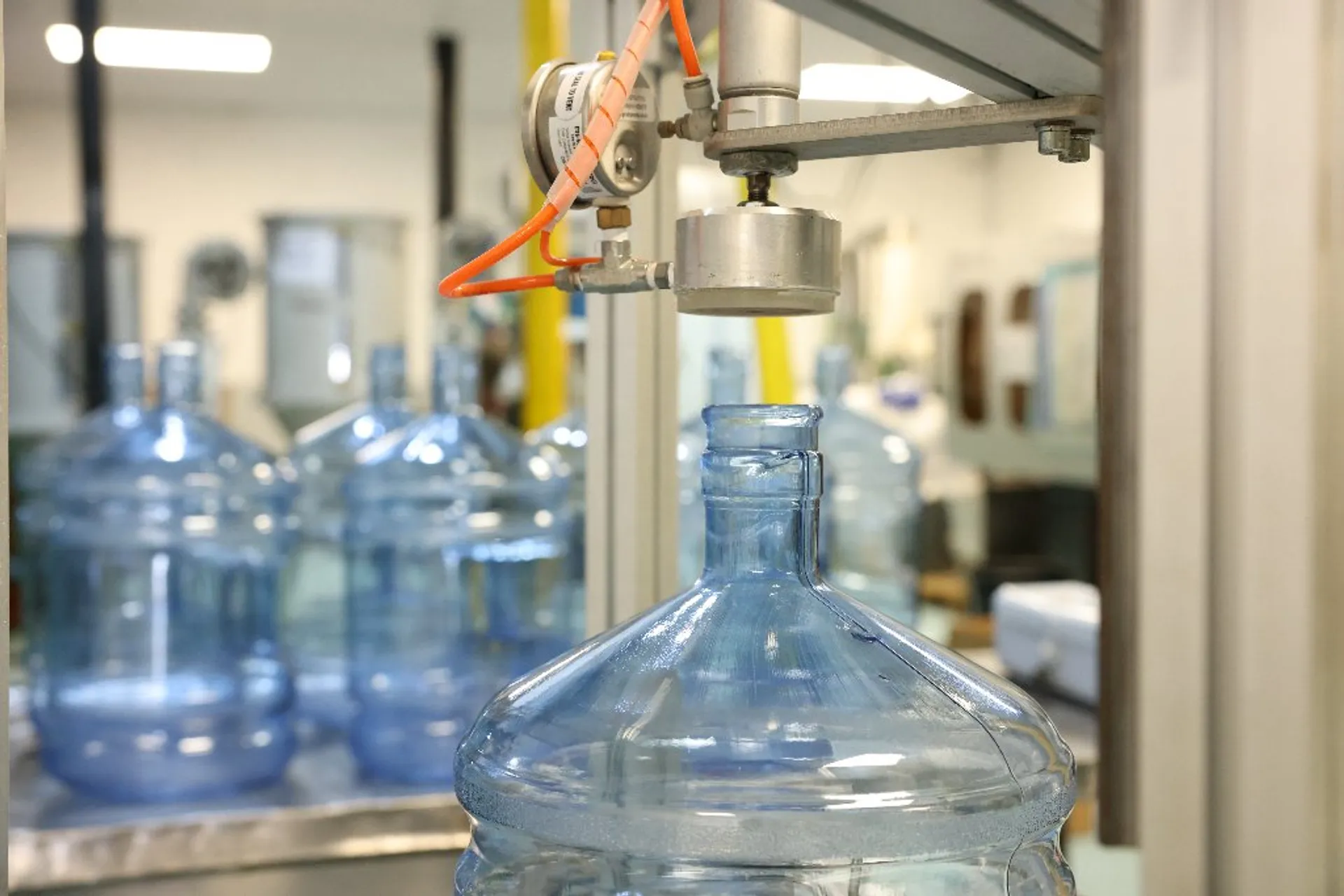
Reusable 18.9L bottles can be exposed to repeated filling, transport, lifting, dispensing, cleaning, storage and customer handling. In a typical operation, a single bottle may be filled, loaded onto a vehicle, transported across a delivery route, unloaded, carried to a customer’s dispenser, placed on a water cooler, collected when empty, returned to the bottling facility, washed, sanitised and refilled — and that cycle repeats many times before the bottle is retired.
This is why bottle consistency and appropriate design matter. A bottle with consistent wall formation, a clean neck finish and a stable base will survive the repeated handling, washing and transport of a delivery operation longer than a poorly made bottle. Bottle design — including the geometry, wall formation, neck and base — affects how the bottle performs under repeated use. Appropriate handling by staff also matters: careful lifting, carrying and loading can help reduce unnecessary physical damage and extend the useful life of each container.
This article does not invent impact-test figures, drop-test results, wall thickness specifications or lifespan claims. How long a bottle lasts in service depends on material quality, manufacturing quality, bottle design, handling, cleaning, storage, environmental conditions and physical condition.
Cleaning and Sanitation
Reusable water bottles require an appropriate cleaning and sanitation process. It is important to understand that cleaning and sanitation are two distinct steps, not the same process.
Cleaning
Cleaning is the physical process of removing dirt, residues and soil from the bottle. For a reusable water bottle, this means washing away mineral deposits, organic matter and any visible soil from the interior and exterior of the bottle. Cleaning is the first step — it prepares the bottle surface for effective sanitation.
Sanitation / Disinfection
Sanitation (also referred to as disinfection) is a separate microbial-control step intended to reduce microorganisms on a clean bottle surface to a level considered safe for the intended application. Sanitation should be carried out after appropriate cleaning and rinsing, because it is most effective on a surface that is already free of visible soil.
Commercial bottle-washing operations should use cleaning chemistry and sanitation processes appropriate for reusable polycarbonate bottles and their specific washing equipment. The cleaning chemistry, sanitation product, temperatures and rinse procedures should all be appropriate for the material, the bottle design and the applicable food-safety requirements for the operation. Do not mix cleaning chemicals together, and always follow the chemical manufacturer’s instructions for each product.
For detailed guidance on cleaning, sanitising and maintaining an 18.9L polycarbonate water bottle, read our article How to Clean and Maintain an 18.9L Polycarbonate Water Bottle.
Bottle Inspection and Replacement
Businesses should regularly inspect reusable bottles for signs of deterioration or damage. Inspection should be built into the cleaning and refilling routine so that damaged bottles are identified before they cause problems on a filling line or at a customer’s dispenser. Examples of what to look for include:
- Cracks — in the body, base, shoulder or neck of the bottle.
- Excessive scratching — deep or widespread scratches that could affect clarity, cleanability or integrity.
- Deformation — changes in shape, bulging or distortion.
- Damaged neck areas — cracks, chips or deformation that could affect closure fit.
- Other visible deterioration — discolouration, cloudiness or crazing that does not resolve with cleaning.
Damaged or unsuitable bottles should be removed from service according to the business’s quality procedures and the manufacturer’s guidance. There is no arbitrary replacement schedule that applies to every bottle. Replacement depends on the bottle’s condition, how it has been used and maintained, and the manufacturer’s guidance. The goal is to remove bottles from circulation before they cause leaks, contamination risk or filling-line stoppages.
Handle vs No Handle
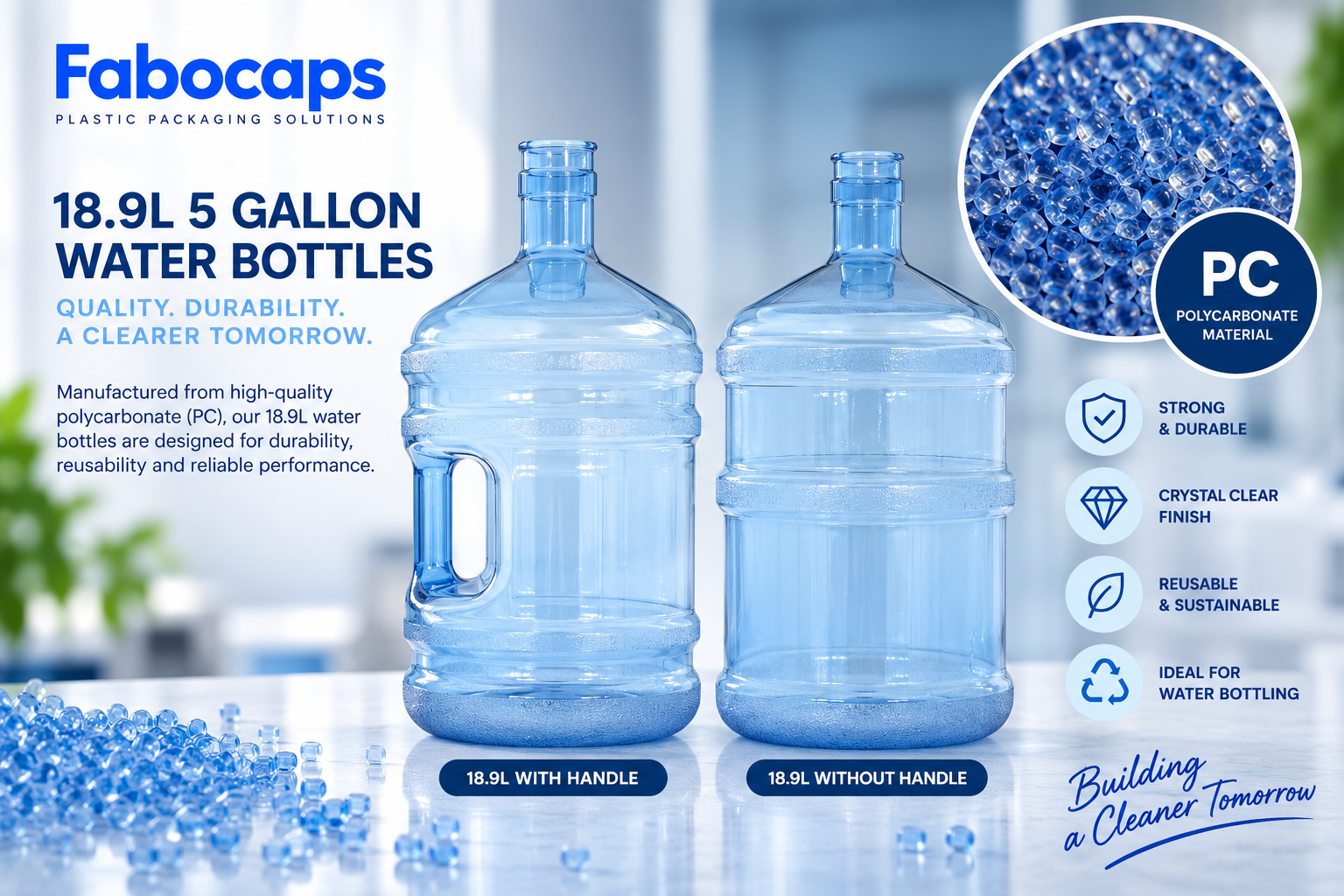
18.9L water bottles are available in two configurations: with a moulded handle and without a handle. The operational difference between the two is significant and affects how bottles are lifted, carried, loaded, delivered and handled.
A bottle with a handle gives the operator a fixed grip point, which makes a full bottle easier to lift, carry and invert onto a dispenser. For delivery staff who move dozens of bottles a day, a handle can reduce strain and the risk of drops. Potential benefits of a handled bottle include easier manual handling and lifting.
A bottle without a handle has a smooth, continuous profile that can be appropriate where handling systems, equipment or business processes make a handle unnecessary. Some operations find a non-handled bottle easier to rack, stack and load by machine, and it may fit certain dispensing cradles more neatly.
Neither design is universally better. Businesses should select the configuration that fits their delivery process, staff handling, dispenser configuration, storage and customer requirements. Many operations run both configurations for different routes or customers.
Explore Fabocaps 18.9L polycarbonate water bottles with and without handle options.
Closure and Neck Compatibility
Bottle selection is not only about the bottle body. Businesses should also consider neck finish, closure compatibility, cap design, sealing and dispensing requirements. A 5 gallon water bottle must have a consistent, precisely moulded neck so that closures — whether non-spill caps, snap-on caps or screw caps — seat cleanly and seal properly. An inconsistent or poorly moulded neck leads to leaks, contamination risk and failed dispenser probes.
Bottle and closure systems should be compatible. The bottle neck and the closure must be designed to work together so that the bottle fills, seals and dispenses correctly. For a bottling line, neck consistency matters because the line runs smoothly only when every bottle accepts the cap the same way. For a water dispenser, the neck and closure must be compatible so the bottle seats cleanly on the dispenser probe and the customer gets a clean, leak-free experience.
Fabocaps supplies compatible non-spill closures and screw caps designed to work with its 18.9L polycarbonate water bottles.
Operational and Logistics Considerations
A reusable 18.9L bottle is part of a complete operational workflow, and the right bottle should fit that workflow. Practical business considerations include bottle handling, storage, transport, washing, sanitation, inspection, filling, dispensing, customer delivery and inventory management. Each of these is affected by the bottle’s design, material, consistency and condition.
- Bottle handling — how bottles are lifted, carried, loaded and unloaded.
- Storage — how empty and full bottles are stored, and in what conditions.
- Transport — how bottles are racked, stacked and moved in vehicles.
- Washing — the cleaning and sanitising process used between refills.
- Sanitation — the microbial-control step applied after cleaning.
- Inspection — the process for identifying and removing damaged bottles.
- Filling — how bottles perform on the bottling line.
- Dispensing — how bottles seat on customer dispensers.
- Customer delivery — how bottles are delivered and collected.
- Inventory management — how bottle stock levels are tracked and replenished.
The right bottle should fit the complete operational workflow, not just one stage of it. A bottle that works well on a filling line but cracks in transit, or a bottle that looks good but does not seat properly on a dispenser, creates operational problems that cost time and money.
Cost and Total Cost of Ownership
The initial purchase price of a bottle is only one consideration. A business should look beyond the unit price and consider the total cost of ownership over the life of the bottle. Total cost of ownership takes into account not only the purchase price but also the costs and considerations that accumulate over the bottle’s service life.
Relevant considerations can include purchase price, durability, handling, washing requirements, cleaning and sanitation, transport, storage, damaged bottle replacement, bottle consistency and supplier reliability. A bottle that costs less upfront but cracks early or causes filling-line stoppages may cost more over its service life than a better-made bottle that lasts longer and runs smoothly. A consistent bottle reduces downtime on the filling line, fewer leaks mean fewer customer complaints, and a reliable supply means the business can plan production and delivery with confidence.
This article does not claim that reusable bottles always save a specific percentage of money, and it does not invent cost comparisons. Businesses should evaluate the total cost of ownership based on their own operating conditions, handling practices, cleaning processes and supply arrangements rather than relying on generic savings claims.
Quality and Manufacturing Consistency
Consistent manufacturing matters to commercial water businesses because inconsistency causes operational problems. A buyer ordering hundreds or thousands of bottles needs every bottle to fill, seal, stack and dispense the same way. Consistent dimensions, consistent neck finish, consistent appearance, material quality, manufacturing control, inspection, packaging and reliable supply together determine whether a manufacturer can hold a standard batch after batch.
Consistent bottle dimensions mean the bottle fills, seals, stacks and dispenses the same way every time. A consistent neck finish ensures closures seat properly bottle after bottle. Consistent appearance — clarity, surface quality, shape — indicates a controlled moulding process. Material quality ensures the bottle performs predictably over repeated refill cycles. Manufacturing control and inspection catch variation before it reaches the customer. Appropriate packaging ensures bottles arrive in good condition. Reliable supply means the business can plan its own operations with confidence.
Consistency can make downstream operations easier. Consistent bottles run smoothly on filling lines, fit dispensers correctly, seal properly with their closures, stack and transport safely, and reduce the number of stoppages, leaks and customer complaints that disrupt operations.
Learn more about Fabocaps quality standards and how each bottle is inspected before dispatch.
Choosing a Supplier
Choosing the right supplier is one of the most important decisions a water business will make. A practical checklist for what a business should look for in an 18.9L bottle supplier:
- Appropriate bottle material — food-grade polycarbonate suitable for reusable water applications.
- Food-contact suitability — material intended and suitable for contact with drinking water.
- Manufacturing consistency — the same bottle, batch after batch, across repeat orders.
- Quality control — inspection and quality management at every stage of production.
- Bottle and closure compatibility — closures designed to work with the bottle neck.
- Handle and no-handle options — bottle configurations to suit different operations.
- Supply capacity — the ability to meet the business’s volume requirements.
- Delivery and logistics — reliable delivery that aligns with the business’s planning.
- Product documentation — material and food-contact information available on request.
- Communication and after-sales support — direct, responsive contact for questions and issues.
- Ability to supply consistently over time — a supplier that can grow with the business.
A supplier that meets these criteria is more likely to provide consistent, suitable bottles at volume over time than one that does not. Businesses should evaluate suppliers on these factors rather than on price alone.
What Businesses Should Ask Before Buying
Before purchasing reusable 18.9L water bottles, a business should ask the supplier the following questions:
- What material are the bottles manufactured from?
- Is the material food-grade and intended for drinking-water contact?
- Are bottles available with and without handles?
- What closures are compatible with the bottle neck?
- What quality controls are used?
- How consistently are the bottles manufactured?
- What are the expected lead times?
- What quantities can be supplied?
- Can the supplier support repeat orders over time?
- What product documentation is available?
- Where are the bottles manufactured?
- Can the supplier provide a quotation?
Why Choose Fabocaps for 18.9L Water Bottles?
Fabocaps is a South African manufacturer of 18.9L / 5 gallon food-grade polycarbonate water bottles and related plastic products, producing bottles for bottling lines, delivery fleets and dispenser networks across South Africa and Africa. Bottle options are available with and without handles to suit different operations.
Manufacturing quality and quality systems are central to how Fabocaps produces reusable water bottles. Each bottle is inspected before dispatch, and the manufacturing process is controlled to produce consistent bottle dimensions, neck finishes and surface quality batch after batch. Fabocaps supplies commercial water businesses with bottles designed for reusable water applications.
This article does not invent production capacity, delivery times, number of customers, market share, guaranteed lifespan, specific savings, certifications not already documented, or test results. Only verified information already available on the Fabocaps website is presented here. Businesses should request applicable product and quality documentation directly from Fabocaps when this information is important to their application.
Explore our 18.9L polycarbonate water bottles, review our Fabocaps quality standards, learn more about Fabocaps, or Request a Quote for current pricing and lead times.
Frequently Asked Questions
What is an 18.9L reusable water bottle?
An 18.9L reusable water bottle is a large-format reusable drinking-water container commonly referred to as a 5 gallon bottle. It holds approximately 18.9 litres of water and is designed to be refilled, sanitised and reused many times, which is why it is widely used by bottled-water businesses, water delivery companies and office water suppliers.
Why are polycarbonate bottles used for 18.9L water?
Polycarbonate is used for 18.9L water bottles because of its combination of clarity, strength, impact resistance and suitability for reusable applications. These properties suit the repeated filling, washing, transport and handling of a delivery operation. Food-grade polycarbonate is specified for bottles in contact with drinking water.
How long does an 18.9L reusable bottle last?
There is no universal lifespan. Service life depends on material, manufacturing, handling, cleaning, storage, environment and bottle condition. A well-made bottle that is handled carefully and maintained appropriately will generally last longer than a poorly made or roughly handled one. Follow the manufacturer’s guidance and remove damaged bottles from service.
Are reusable water bottles safe?
Safety depends on appropriate food-contact material, manufacturing quality, intended use and proper cleaning and sanitation. A bottle made from appropriate food-grade material, manufactured consistently, used as intended and properly cleaned, sanitised and inspected is a different proposition from a container that does not meet these conditions. Buyers should request material and food-contact documentation from their supplier.
Should businesses choose bottles with or without handles?
The choice depends on handling, delivery, storage and operational requirements. A delivery route where staff carry bottles by hand will usually benefit from handles. An operation where bottles stay in racks and are loaded by machine may not need them. Many businesses run both configurations for different routes or customers.
What should I ask a bottle supplier?
Refer to the buyer checklist in this article. Key questions include what material is used, whether the bottle is intended for food/water contact, what quality controls are in place, whether the supplier can support repeat orders, and what product documentation is available.
Conclusion
Reusable 18.9L / 5 gallon water bottles are a core operational asset for water businesses, and choosing the right bottle comes down to material, durability, handling, cleaning, sanitation, inspection, handle configuration, closure compatibility, operational fit, total cost of ownership, manufacturing consistency and supplier selection. Each factor affects how the bottle performs in service — from the filling line to the customer’s dispenser — and together they determine the reliability and cost of the operation. Looking for reusable 18.9L 5 Gallon Water Bottles for your business? Request a Quote and our team will help you specify the right configuration for your operation.
Looking for 18.9L 5 Gallon Water Bottles?
Fabocaps manufactures and supplies 18.9L polycarbonate water bottles for customers in South Africa and across Africa.